
Anxiety Is Quietly Shrinking Your Life. Here Are the Proven Therapies to Reclaim It


You’re not broken. Anxiety just wants you to believe you are.
If you’ve ever canceled plans, avoided hard conversations, or put off things you care about, not because you’re lazy but because anxiety made them feel impossible, you’re not alone.
This is what anxiety does.
It doesn’t always show up loudly.
Sometimes, it hides in the background. Over time, it pulls you away from the things that matter: your goals, your relationships, your confidence, and your sense of self.
At The Anxiety Center, we help people reclaim what anxiety has slowly taken.
We use evidence-based treatment, compassionate care, and a process that meets you exactly where you are.
How Avoidance Feeds Anxiety and Shrinks Your Life
What feels like procrastination or distraction is often something deeper.
Avoidance isn’t always intentional.
Sometimes it's your brain’s subtle, subconscious attempt to protect you from discomfort. You might delay a decision, skip a stressful event, or steer clear of something that feels overwhelming.
In the moment, that relief feels good.
But over time, it comes at a cost.
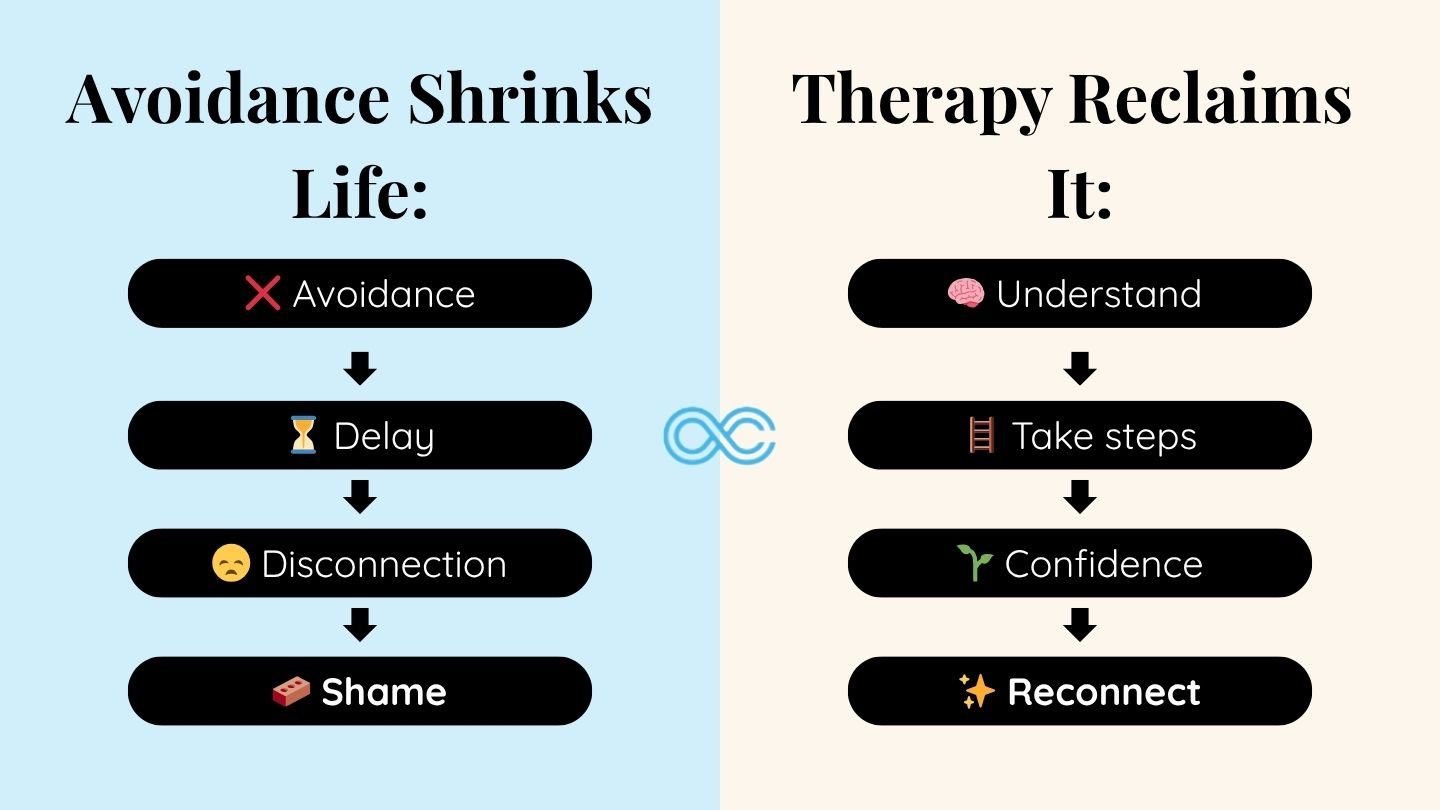
Avoidance teaches your brain that discomfort equals danger.
It reinforces the idea that escape is the only option.
The more you avoid, the more powerful anxiety becomes.
You might fall behind in school, at work, or in reaching life milestones.
You might feel disconnected, lose confidence, and carry a quiet sense of shame or frustration that you’re stuck.
“Avoidance is central to what maintains anxiety,” explains Dr. Nathan Fite, Clinical Director at The Cincinnati Anxiety Center. “When someone avoids a feared situation, the brain doesn’t learn that the threat was actually safe.”
The brain can also learn safety.
That’s where therapy comes in.
It helps you slowly unlearn avoidance and rebuild your sense of confidence, connection, and control.
Therapy That Helps You Reclaim Your Life
At The Anxiety Center, we use cognitive behavioral and exposure-based approaches to help you move toward your values, goals, and the future you want.
These are not just emotional tools. They are strategies grounded in research and real outcomes.
Here are a few of the core methods we use:
- Cognitive Behavioral Therapy (CBT), which helps you recognize and change thought patterns that fuel anxiety. It also helps eliminate safety behaviors that prevent recovery.
- People receiving therapist-guided CBT are more than twice as likely to recover from anxiety and depression compared to those using self-help methods. In a meta-analysis of over 52,000 participants, 36% of those in therapist-guided treatment achieved remission, compared to just 15% in control groups. (Cuijpers et al., 2023)
- Exposure and Response Prevention (ERP), which helps you face fears gradually, without relying on avoidance or compulsions.
- People who received Exposure and Response Prevention (ERP) along with medication had 16.5% greater symptom relief than those who used medication alone. This included fewer intrusive thoughts, reduced compulsions, and improved daily functioning. (Gu et al., 2022)
- Behavioral Activation, which encourages small, intentional steps toward things that give your life meaning.
- A 2023 randomized clinical trial found that individuals undergoing Behavioral Activation therapy for Generalized Anxiety Disorder experienced significant reductions in anxiety symptoms, comparable to those receiving exposure-based therapy. Notably, participants in the BA group reported more rapid improvements during treatment and greater overall satisfaction with their progress. (Berg et al., 2023)
- A 2023 randomized clinical trial found that individuals undergoing Behavioral Activation therapy for Generalized Anxiety Disorder experienced significant reductions in anxiety symptoms, comparable to those receiving exposure-based therapy. Notably, participants in the BA group reported more rapid improvements during treatment and greater overall satisfaction with their progress. (Berg et al., 2023)
A Story From a Member of Our Community
Michael Siman, a therapist at our Cincinnati office, shared this experience:
“One of my favorite moments as a therapist was with a client who struggled with agoraphobia and a fear of heights. We started small, visiting places like Mount Adams and Clifton that offer scenic views. Eventually, we walked across a bridge he had been terrified of for years. That moment was a major breakthrough. He told me his dream was to fly on a plane, and crossing that bridge felt like his first real step toward that goal.”
Sometimes progress looks small. But to the person experiencing it, it changes everything.
What It’s Like to Start Therapy at The Anxiety Center
Lucky for you, we’ve designed our intake process to make it simple and personal.
Here are the 4 small steps to get started:
📄 Short form → ☎️ Human call → 🎯 Therapy Method Selection → 💬 First session scheduled.
- First, you share your basic details and schedule a call back. It takes 30 seconds.
- Then, you’ll speak directly with one of our local clinicians who listens and helps you understand the right next steps
- If you feel it's the right move, we’ll help you
- navigate to the right therapy
- Choose either in-person sessions (Cincinnati, Dayton, or Indianapolis), virtual, or hybrid sessions
- Help you navigate payment options like Medicaid, insurance, or out-of-pocket.
- There’s no pressure and no rush. We move at the pace that works best for you.
You Don’t Have to Stay Stuck
You’re not alone. Whether you're in Cincinnati, Dayton, or Indianapolis, we’re here with you. We’ve helped thousands of people move forward, even when it felt impossible.
If you're ready to talk to someone who gets it, we’re here, and the first step is simple. Book a Free Call / Pick a free Callback Time
You are not alone. We are here with you. Whatever it takes
What Treatment at The Anxiety Center Actually Looks Like
How We Treat Anxiety at TAC
DISCLAIMER: This content is for informational purposes only and does not constitute medical advice, diagnosis, or treatment; always consult a licensed professional.