
How Does Group Therapy in an Intensive Outpatient Program (IOP) Actually Work?

How Does Group Therapy in an Intensive Outpatient Program (IOP) Actually Work?
When people first hear about an Intensive Outpatient Program (IOP), one of the most common questions is about group therapy.
Many people wonder:
- What actually happens in group therapy?
- Why is group therapy used instead of only individual therapy?
- Will it really help if other people’s struggles look different than mine?
These are reasonable questions.
The reality is that group therapy is the core of most intensive outpatient programs, especially for conditions like anxiety, OCD, and depression.
Understanding how it works can make the idea of IOP feel much less intimidating.
Serving: Cincinnati • Dayton • Indianapolis
Why Is Group Therapy the Core of an Intensive Outpatient Program (IOP)?
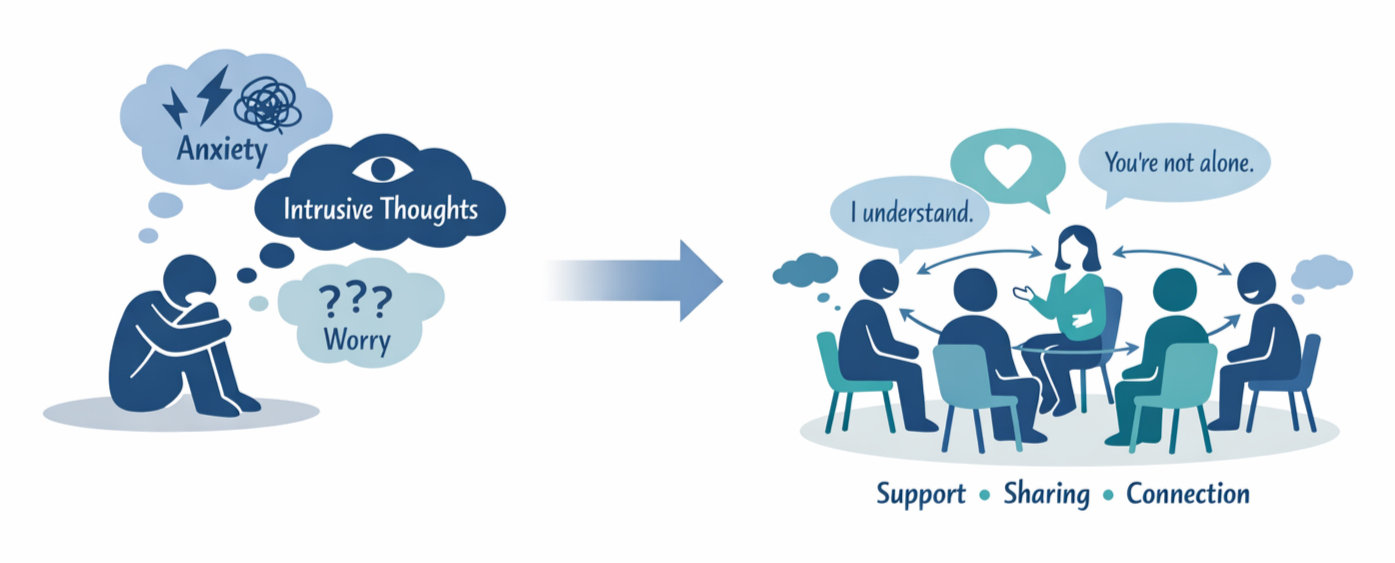
Group therapy is central to IOP because it helps people realize they are not alone in their mental health struggles.
Many individuals entering treatment spend a large amount of time inside their own thoughts.
Anxiety, depression, and OCD can create a cycle where someone becomes isolated, constantly analyzing their worries without outside perspective.
Group therapy interrupts that pattern.
In a structured group environment, people begin to notice something important:
Even if the content of their worries is different, the process underneath those worries is often the same.
Many people are dealing with:
- intrusive thoughts
- intense uncertainty
- emotional distress
- behaviors designed to escape or reduce that distress
Recognizing this shared process reduces shame and stigma.
It helps people move away from the belief that their struggles are uniquely broken or different from everyone else.
Group therapy also creates a space where individuals can contribute to others’ progress.
Sharing experiences, offering encouragement, and supporting peers often strengthens motivation and meaning in recovery.
For many people, that sense of community becomes one of the most powerful parts of treatment.
What Happens During an IOP Group Therapy Session?
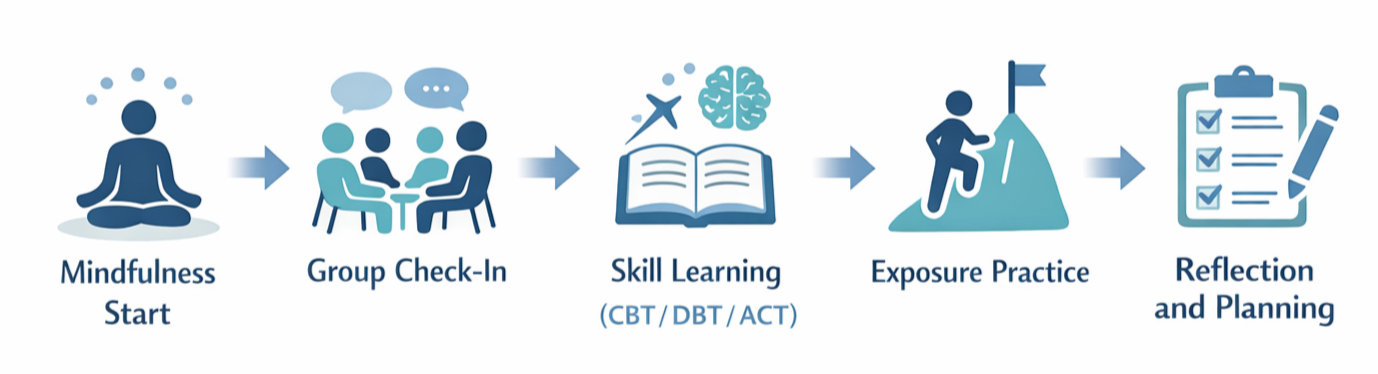
Every intensive outpatient program has its own structure, but most sessions follow a consistent framework designed to combine education, skill development, and real-world practice.
A typical session often includes several key components.
Mindfulness and grounding
Many groups begin with a short mindfulness exercise.
This helps participants slow down, become aware of their current mental state, and practice redirecting attention to the present moment.
This skill becomes the foundation for many other therapeutic strategies.
Group check-in
Participants then check in about how they are doing.
This may include discussing:
- recent challenges
- progress since the last session
- situations where symptoms showed up
- wins or breakthroughs
These discussions help normalize experiences and allow participants to learn from one another.
Skill-building and psychoeducation
The next portion of the session typically focuses on learning new tools.
Depending on the program, this may include techniques from evidence-based approaches such as:
- Cognitive Behavioral Therapy (CBT)
- Exposure and Response Prevention (ERP)
- Dialectical Behavior Therapy (DBT)
- Acceptance and Commitment Therapy (ACT)
Participants learn how certain patterns maintain anxiety, OCD, or depression, and how new behavioral strategies can interrupt those cycles.
Live practice
One of the biggest advantages of IOP is that skills are not only discussed, they are practiced.
For example:
Someone with contamination OCD may practice touching feared objects while resisting compulsive behaviors.
Someone with social anxiety may practice initiating conversations or making eye contact.
Someone working on intrusive thoughts may complete imaginal exposures designed to reduce fear over time.
These exercises allow people to experience the process of distress rising and falling, which helps the brain learn that feared situations are tolerable.
Reflection and planning
Sessions typically end with reflection.
Participants discuss:
- What they noticed during practice
- challenges that came up
- lessons learned
- goals for applying skills outside of treatment
This process helps translate what happens in therapy into daily life.
Why Is Group Therapy So Effective for Anxiety, OCD, and Depression?
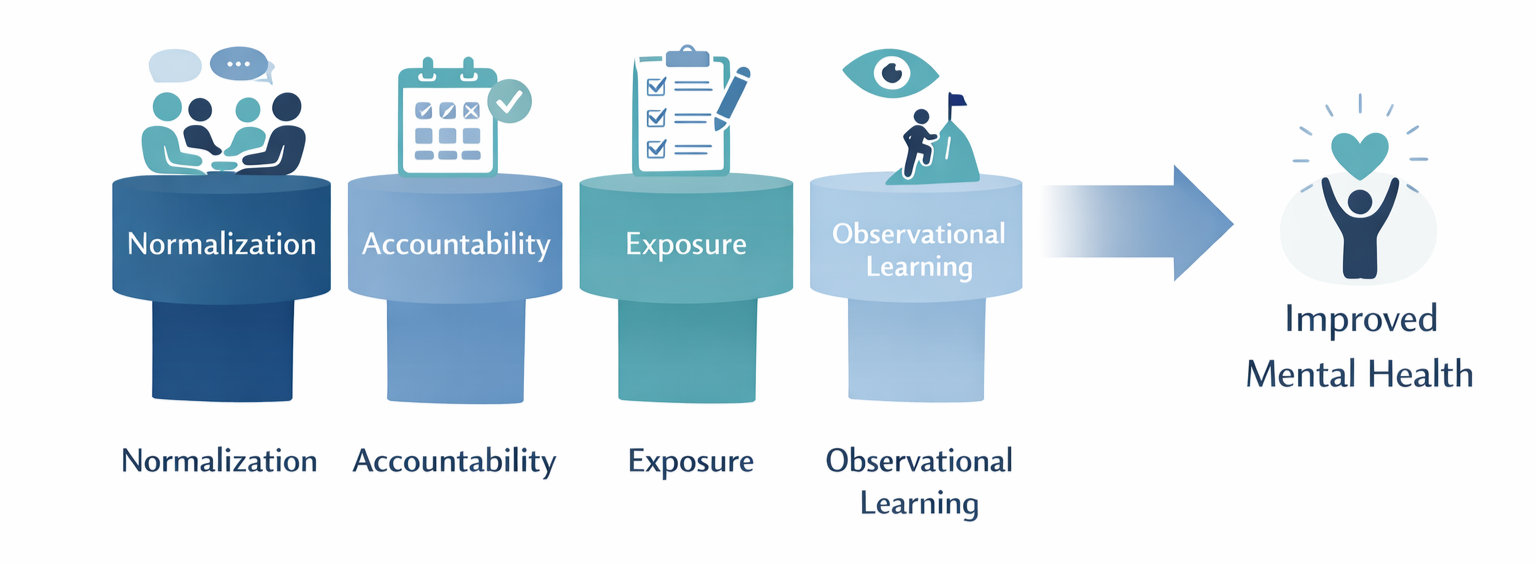
Research consistently shows that group therapy can be highly effective for many mental health conditions.
Several mechanisms help explain why.
Normalization reduces shame
Hearing others describe similar fears, intrusive thoughts, or emotional struggles can significantly reduce feelings of isolation.
Many participants realize they are not the only ones experiencing these challenges.
Built-in accountability
Attending group therapy requires active participation.
Even small actions, such as listening, sharing, or offering feedback, can help break patterns of avoidance.
For individuals with depression, this participation can function as behavioral activation, which is known to improve mood over time.
Natural exposure opportunities
Group settings naturally create opportunities for exposure.
Speaking in front of others, sharing personal experiences, or engaging socially can help individuals gradually reduce anxiety related to social situations.
Observational learning
Participants often learn by watching others apply coping strategies.
Seeing someone else tolerate discomfort or challenge negative thinking can sometimes be more powerful than simply hearing instructions from a therapist.
Community and motivation
Watching other group members improve can increase hope and motivation.
Seeing real progress in others helps reinforce the belief that recovery is possible.
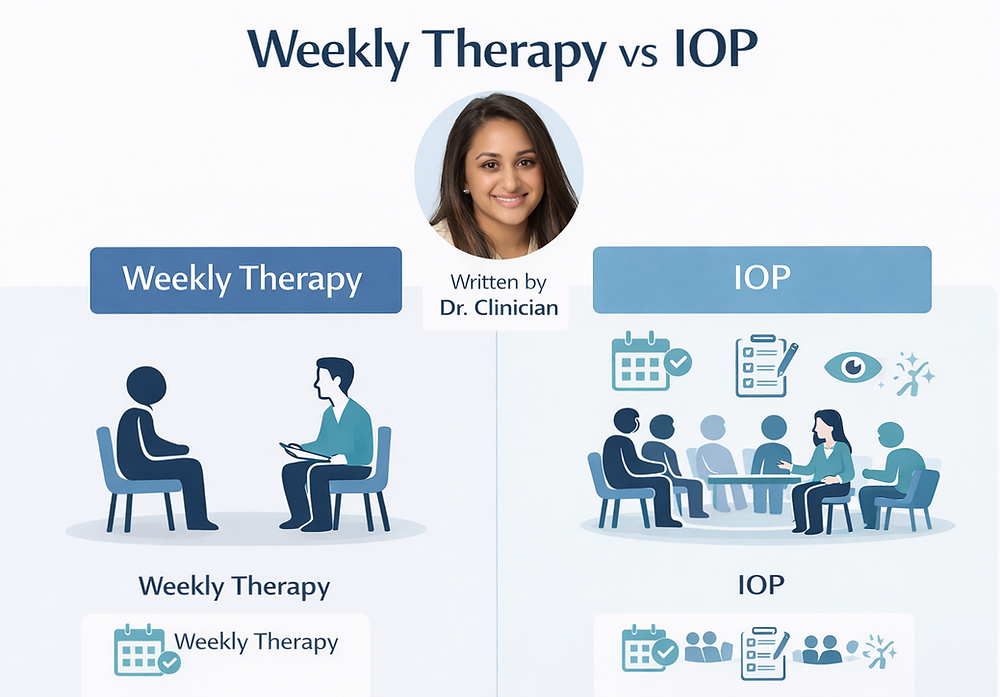
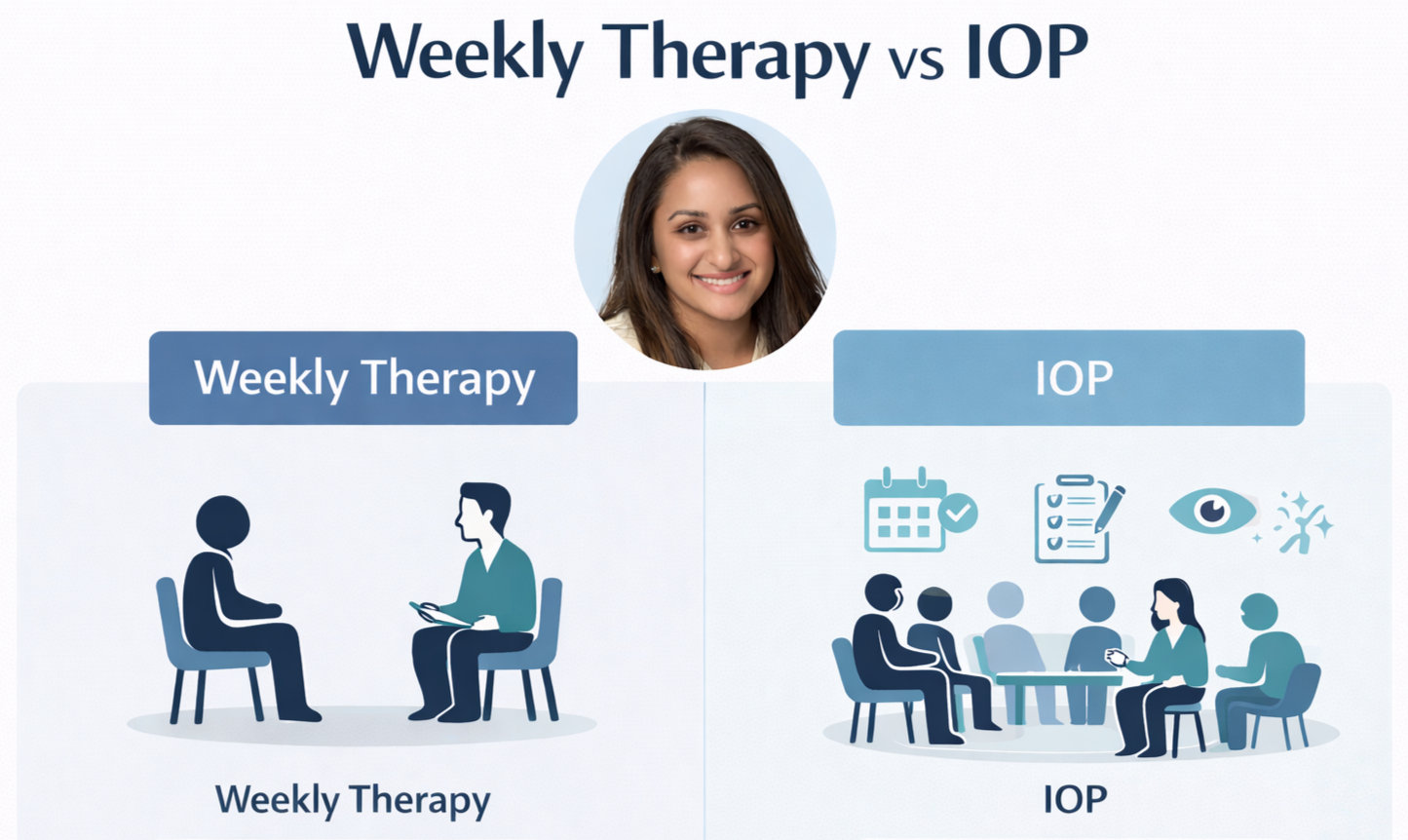
How Is IOP Group Therapy Different From Weekly Individual Therapy?
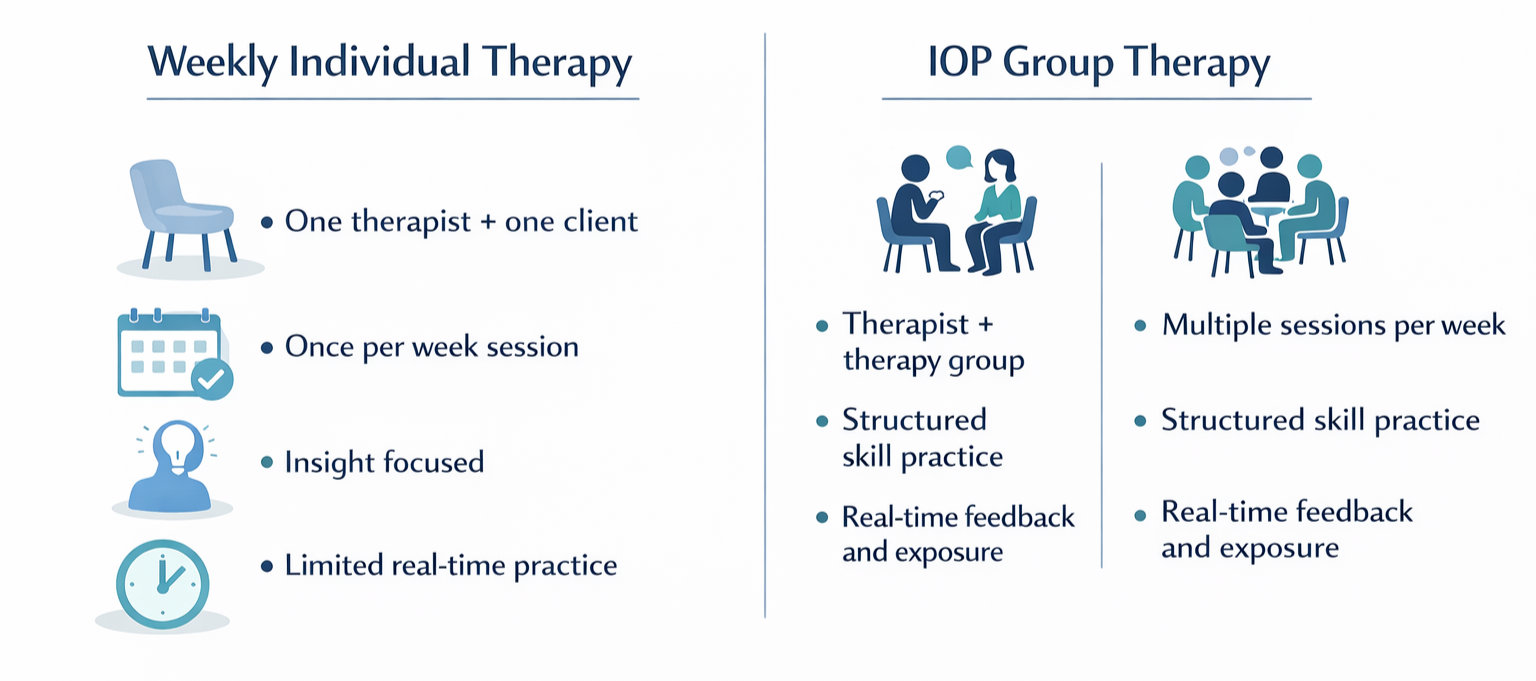
Weekly individual therapy and intensive outpatient programs both play important roles in mental health treatment, but they serve different purposes.
Frequency and intensity
Weekly therapy usually involves one session per week.
IOP typically involves multiple sessions per week, often totaling 9 to 15 hours of treatment.
This higher dose of therapy allows individuals to practice skills repeatedly in a short period of time.
Learning environment
In individual therapy, learning primarily occurs through conversations between one client and one therapist.
In group therapy, learning also happens through peer interactions, modeling, and feedback.
Participants benefit from hearing different perspectives and seeing how others apply coping strategies.
Skill practice
While individual therapy may introduce tools, group therapy often provides more opportunities to practice those tools in real time.
This repeated practice can accelerate progress.
Social learning
Group settings allow people to practice interpersonal skills, challenge social fears, and receive feedback in a supportive environment.
For individuals with social anxiety, this exposure can be especially valuable.
Cost effectiveness
Group therapy is often more cost-effective than receiving many hours of individual therapy per week, while still providing intensive support.
Many individuals in IOP also continue working with their individual therapist alongside the program to maintain continuity of care.
How Do You Know If Group Therapy in an IOP Might Help You?
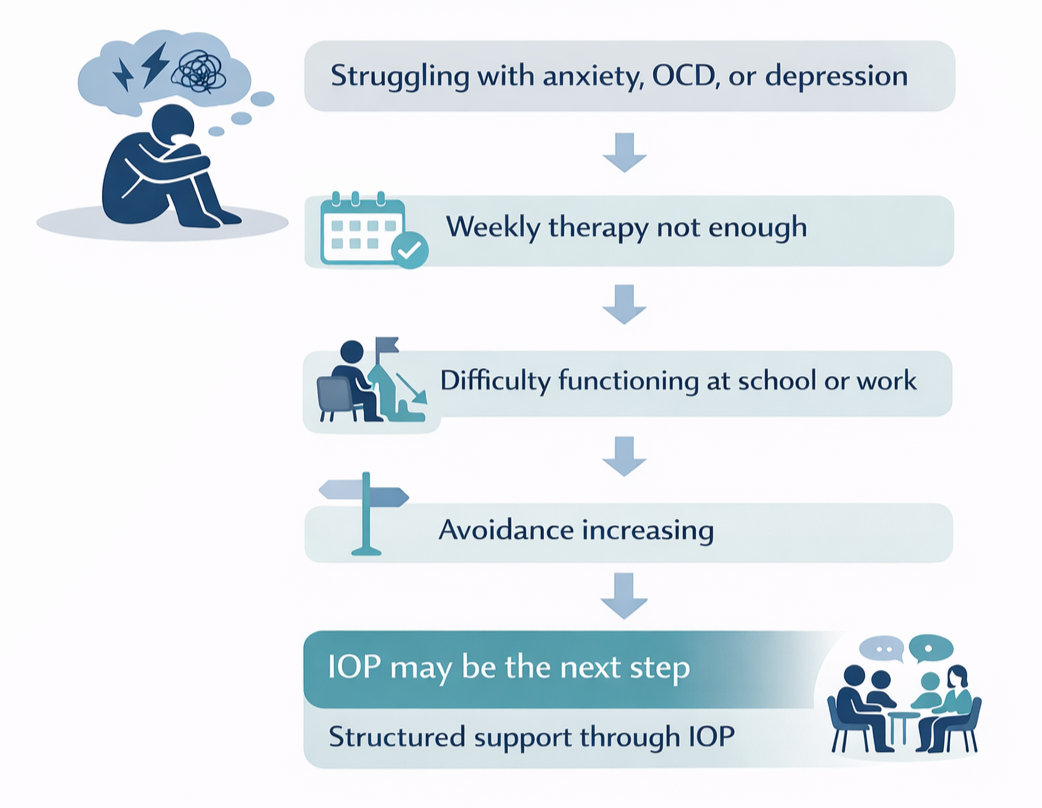
An Intensive Outpatient Program may be a good fit if someone feels that weekly individual therapy alone is not providing enough support.
IOP is often recommended when symptoms are moderate to severe and begin interfering with daily functioning.
Some common signs include:
- persistent anxiety, OCD, and depression.
- difficulty getting out of bed or completing daily responsibilities
- difficulty functioning at school or work
- increasing avoidance of school, work, or social situations
- feeling stuck despite ongoing therapy
- needing more structure and accountability
An Intensive Outpatient Program (IOP) provides multiple therapy sessions each week, allowing individuals to practice evidence-based strategies consistently and receive real-time guidance from clinicians.
If avoidance is increasing and your world feels like it is getting smaller, additional education and caregiver support can also help.
A good starting place is Caregiver University.
However, IOP also requires active participation and a meaningful time commitment.
Most programs involve several hours of therapy per day across multiple days each week.
For individuals ready to engage in treatment and dedicate time to recovery, the increased intensity of IOP can significantly accelerate progress.
Your next step can be as simple as a free 15-minute consultation to find out whether IOP is the right level of care.
The Bottom Line
Group therapy in an Intensive Outpatient Program is not simply a place to talk about problems.
It is a structured environment designed to help people practice real skills, challenge patterns that maintain mental health symptoms, and build momentum toward recovery.
Through community, accountability, and repeated practice, many people begin to regain confidence in their ability to manage anxiety, OCD, depression., and other mental health challenges.
For individuals who feel stuck or overwhelmed despite weekly therapy, IOP can provide the additional support needed to move forward.
Available in: Cincinnati, Dayton, and Indianapolis
Next step: Schedule a free 15-minute consultation to see whether IOP is the right fit.